I have in front of me the catalogue for the exhibition Heavenly Beings. Neither Human nor Animal, which opened in the summer of 2018 at the Museum of Contemporary Art Metelkova (+MSUM) in Ljubljana, Slovenia. The exhibition itself unfolded in two parts, as if to illustrate how, on the one hand, we idealize animals: celebrating unusual alliances with our pets, domesticating the wild, or designing idealized bestiaries that reach back to primordial times when a lion and a sheep supposedly shared the same den.
We use animals for mythological purposes. We also use them—and this was the other hand, the dark opening of the exhibition—for practical purposes, for food and clothing. The place where an animal is turned into meat is called a slaughterhouse. Before it lands in pots and on tables, the meat has already been infused with dread and fear during the animal’s final hours. But an animal’s fate can be worse still: the laboratory. At least 115 million animals—rodents, birds, fish, rabbits, guinea pigs, dogs, and cats—are killed every year in animal testing, mostly in American laboratories, for no reason other than human compulsion to prove that our lives are more precious.
John Stuart Mill, in his essay On Nature, posits that nature is nightmarishly cruel, and that human civilization brings a measure of assuagement and mitigation to the endless parade of predators devouring helpless prey. As the recent Netflix series Nightmares of Nature demonstrates, animal lives can easily turn into a veritable nightmare even without human interference. Human presence, however, is like a deadfall trap—a crushing inevitability, a totalitarian rule, an ultimate message that no place on earth is ever truly safe: a rainforest can be felled, a coral reef destroyed, and you, hapless creature, have nowhere left to turn for refuge.
In 2022, as a result of an ecological catastrophe, nearly 90% of mussels and snails in the Odra River died, and in the entire polluted stretch the fish populations were reduced by more than 60%. The Odra continues to suffer from toxic discharges; this has become its new status quo. The errors that led to the crisis several years ago have not been corrected. As the performance Smutna Rzeka (Sad River) makes clear, the culprits are known. They also remain entirely unbothered.
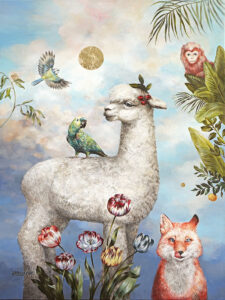
Our new issue of Polish Gothic titled Magical Creatures reflects this duality, this split in the human perception of animals: paradise on one side; slaughterhouse on the other.
We enter the paradise via the paintings of Olga Ottenheijm‑Selyshcheva, a Dutch‑Ukrainian artist and curator based in Leiden, whose work has been shown in over a hundred exhibitions across Europe and beyond. She often presents animals in idyllic settings that a discerning viewer will not accept at face value. Selyshcheva was born in Kharkiv, and another series of hers, titled Unstoppable Freedom, features two birds of paradise (or perhaps simply parakeets) painted in vivid blue and yellow. The meaning is clear: Ukraine is going to win freedom because its progress is unstoppable. Several of her paintings have this otherworldly, paradisiacal effect, and her red fox is the only hunter we can tolerate.
Now, as to the slaughterhouse, Baldwin E. Hart’s Hares Hunting Hares comes forth, written in a deliberately Shakespearian English. Slow reading is required to enter this dreadfully sad story set in an alternative universe where hybrid creatures—their personalities shaped by their animal traits—have been habituated to cannibalism, though only the poor, the sick, and the animals of prey are victims so far, at least officially. The structure of this world is not as extensively developed as in Agustina Bazterrica’s Tender Is the Flesh, but the impulse that drives its protagonist toward slaughterhouse employment is strikingly similar. Maynard, a hare‑like creature, is propelled by grief—his father is dying despite his efforts—and by his own status as prey and potential victim. His transient happiness may end the following day, with a denunciation.
And perhaps this is the most disturbing aspect of Hart’s story: not that humans would ever be habituated to cannibalism, but that we are already habituated to the visibility of violence when it is packaged as consumer comfort. A few months ago, my neighborhood Lidl installed what I can only call a “tower of meat”: once, one had to bend down to see the bloody trays; now blood and viscera sit at eye level, and shoppers pass them without a thought. The “tower of meat” is no small monument to the normalization of violence (blood and guts presented as décor), followed by desensitization, as this commodified brutality becomes simply part of the shopping landscape (shoppers pass it without noticing because the supermarket has framed it as ordinary). Would shoppers accept cannibalism as well with a bit of pressure and consumerist propaganda? Who knows.
Against the background of black‑and‑white photographs of deserted slaughterhouse interiors on the walls of the Museum of Modern Art at Metelkova, the multimedia artist Igor Grubić printed a series of urgent questions: “Do animals have legal rights?”, “Do animals know they are products?”, “Do animals dream about freedom?”, “Do animals survive extermination?” His project Do Animals…? (2017), based on research into former slaughterhouses in northern Italy during his RAVE East Village Artist Residency, investigates the psychological effects of working in these “factories of death,” as he calls them, on human consciousness.
These questions are expanded and reiterated in Zoopolis: A political Theory of Animal Rights by Sue Donaldson and Will Kymlicka (2011), written in continuation of the debates opened by Cass R. Sunstein and Martha C. Nussbaum in Animal Rights: Current Debates and New Directions (2004). To give a brief overview: the Society for the Prevention of Cruelty to Animals was established in Britain in 1824, marking the beginning of modern animal‑rights advocacy. But small victories should not distract us if, in the meantime, the human population has nearly doubled in the last fifty years (from roughly 4 billion in 1974 to over 8 billion by early 2024). During the same period, wild animal populations have dropped by 73%. Freshwater populations have experienced an 85% decline. We are living through a severe crisis in biodiversity; some species are already safer in zoos and wildlife sanctuaries than in their natural habitats.
We have created the state that Charles Patterson calls an “Eternal Treblinka,” as “animal exploitation underpins the way we feed and clothe ourselves, our forms of entertainment and leisure, and our structures of industrial production and scientific research,” as Donaldson and Kymlicka point out. To counteract this state of affairs, three responses have been developed so far: a “welfarist” approach, an “ecological” approach, and a “basic rights” approach. The welfarist view accepts that animal welfare matters but maintains that animals may be used, within limits, for human benefit (slaughterhouses and laboratories are permitted, without excess cruelty). The ecological view focuses on the health of ecosystems and argues against habitat destruction, yet supports the killing of “invasive species” if such actions are deemed beneficial to ecological balance. Finally, the animal‑rights framework holds that animals, like humans, possess certain inviolable rights and are neither servants nor slaves of human beings. But this approach, as Donaldson and Kymlicka note, remains politically marginalized.
What remains is the question of a voice. Animals do not speak human languages, to their detriment. Not many people know that the Polish poet Adam Mickiewicz proved himself a staunch supporter of animal rights. In a lecture delivered on 19 March 1844 at the Collège de France in Paris, he argued that the liberation of animals should accompany the liberation of Slavic peoples, for he believed that those living in Eastern Europe—themselves, in his view, rendered voiceless by the West—were especially positioned to cultivate empathy, or what he calls współodczuwanie, with animals. This requires a conscious effort to cross the borders between the human and animal kingdoms; and, Mickiewicz insisted, this effort must come from humans, not from animals. As he put it:
Obywatele tego królestwa [zwierząt] dalej odbywają swoje zebrania w sąsiedztwie mocarstwa człowieczego; ale między tymi dwoma państwami nie masz żadnej styczności: ani jeden wyraz, ani jeden znak nie przeszedł z mowy jednych do słownika drugich. (122)
The citizens of that kingdom [of animals] continue to hold their assemblies in the vicinity of the human empire; yet between these two realms no bond of intercourse exists: not a single word, not a single sign has passed from the language of one into the vocabulary of the other.
Our spiritual obligation, then, is to communicate with the (seemingly) mute inhabitants of the animal world. Mickiewicz continues:
Widzicie, o ile trudniej ukochać niewolnika niż pisać o niewolnictwie i jak to jeszcze niezmiernie trudno rozszerzyć naszą duszę tak, aby objęła jednakowym uczuciem plemiona świata niemego, rozbudzić w naszym duchu taką przenikliwość, która by pozwalała odczytywać, co się kryje w ich spojrzeniach i ruchach. (124)
You see how much harder it is to love a slave than to write about slavery, and how exceedingly difficult it is to expand our soul so that it embraces with equal feeling the tribes of the mute world—to awaken in our spirit such sensitivity that it allows us to read what is hidden in their glances and movements.
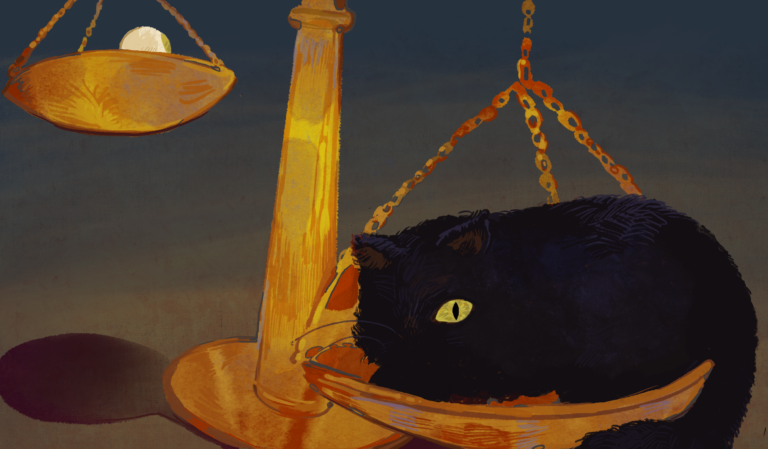
As writers, we are particularly endowed for this task of transcribing what Éric Baratay calls The Animal Point of View. Several stories published in this issue attest to that. Such is The Black Cat Takes the Stand by Paulina Jakimowicz (a spin‑off from Edgar Allan Poe’s “The Black Cat” of 1843), Obey Your Master by Beata Williamson (a 1984 take on the 1984 mindset, told from the point of view of a dog), or Little Fire by Gabriela Woltman (narrated by a solitary female wolf who normally despises humans, equating them with hunters, but once makes an exception). Quite often it is the voice that matters, and it may be the voice of a hybrid, as in Osteoderms by Berenika Goździk, or of a human narrator driven into insanity by repressed guilt and a lack of spine—an inability to stand up to bullies in defense of a friend—as in A Bell Rusted Red by Patrycia Murzyniec‑Kamińska.
Others present a valiant effort at empathy or embrace the underlying belief that human lives are just as precarious as those of animals, as in The Rotting Mice of August by Nora Hultman (where the conclusion follows that both lives matter equally), or in Berry Picker by Kinga Jacewicz, which traces the tentative alliance between a child and a animal ally in the making and an actual wild animal. And yet, since we are Gothic writers, we extend this empathy toward fantastic animals and magical creatures that inhabit myths, fairy tales, and imagination. Such is Nykur by Natan Richert and Kikimora by Maja Zamiejska. These fantastic beings, these apparitions, tend to be entangled in human affairs as much as real blood‑and‑flesh animals are; and as Stay by Sarah Flamminio demonstrates, Appalachian outdoor landscapes can be as uncanny and suffocating as their seldom‑ventilated interiors, metaphorically speaking. Others declare that they are done with human allies altogether, like the insatiable bird of vengeance in Jan Piszczek’s Eye for an Eye.
In the Gothic imagination, every creature, real or fantastic, becomes a witness to the world we have made and the world we might still save. Perhaps this is why magical creatures matter: they remind us that the border between paradise and nightmare is thin, permeable, and inhabited. Not by adversaries, not by opposites, but by neighbors—and Gothic writing teaches us to listen to the creatures who move between them.