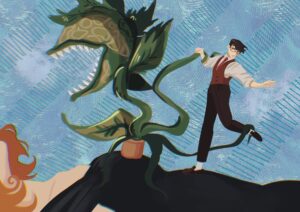
The 1986 film Little Shop of Horrors, directed by Frank Oz, is a cult classic for a reason. The movie is based on the 1982 stage show adapted from the 1960 horror comedy of the same name by Alan Menken and Howard Ashman, the legendary duo who would later be recognized for creating Disney hits like The Little Mermaid, Beauty and the Beast, and Aladdin. Contemporary audiences can enjoy the off-Broadway production directed by Michael Mayer, which opened in 2019, and its cast recording with Jonathan Groff starring as Seymour, which is available online.
The musical tells the story of Seymour and Audrey, flower shop employees who dream of escaping poverty-stricken Skid Row. Their lives are changed when an exotic plant, which Seymour names Audrey II as a tribute to Audrey, rapidly growing under Seymour’s care, attracts attention and brings in new customers. The only catch is the fact that the plant feeds only on human blood and very quicky demands that Seymour kill people for it to eat. In exchange, Audrey II offers Seymour anything he wants.
Little Shop of Horrors very intentionally shows the story in a way that’s “parodying American musical comedy” (Ashman qtd. in Howard). Narrated by a singing trio, Chiffon, Ronnette, and Crystal, who serve as a Greek chorus, the movie is not afraid to be a musical and proves so by unapologetically embracing the kitsch, over-the-top quality of the show. The set resembles a stage with a painted sky, and the “excellent 60s setting where the world seems like a cartoon in the best possible way” makes the exaggerated, theatrical aspects of the movie shine (“Little Shop”). The movie plays with the viewer from the opening scene where what looks like a grand shot of a galaxy turns out to be a muddy puddle someone throws an empty bottle into. These remarkable transitions between scenes smoothly move the story forward and make the camera movement part of the choreography.
But what is this weird story really about? In the TV series Only Murders in The Building, Meryl Streep’s character, Loretta, talks about how the show “at heart, is just a simple story of a boy who would do anything for the girl he loves.” It is true on some level, but, to me, this story is more about two people so in love with their dream that they get literally consumed by it (pun intended). The main characters are representatives of the American dream. Seymour is an orphan who finds success through hard work that literally costs him blood, sweat, and tears. Audrey, on the other hand, is an example of a troubled girl with a heart of gold, who craves to be saved by a successful man. In her song, “Somewhere That’s Green,” she dreams about mundane things like kitchen appliances and Tupperware parties she read about in magazines (Ashman qtd. in Howard). The song presents “her not only as without real hope, but also as striving toward the impossible ideal of the 1950s housewife sequestered in her pristinely suburban home ‘straight out of Better Homes and Gardens’” (Jensen 59). Seymour might help her achieve that.
It is generally recognized that Audrey II is a metaphor for greed, consumerism, and capitalism. In his video essay about the musical Dan Drambles explains how the musical is an unsubtle commentary on consumerism and quotes Jensen, who points out that all of the plant’s victims “stand as obstacles to Seymour’s happiness or social mobility, and by giving in to Audrey II’s urging, Seymour is actually expressing his own greed” (“Little Shop”). The plant is Seymour way out of poverty, allowing him to become someone else, and he is willing to feed it despite the cost.
Interestingly, the movie has two endings. The original one, faithful to the stage show, concludes the story by Audrey II wounding Audrey, whose dying wish is to be fed to the plant because she’s happy to end up “somewhere that’s green.” Then Seymour dies trying to avenge Audrey’s death. What comes next is a sequence of the alien plant massacring America with Chiffon, Ronnette, and Crystal singing “Don’t Feed the Plants” in the background. However, this is not the ending that was shown during the theatrical release. After preview screenings of the film, the audience hated the idea of the main characters dying. Ironically, for the movie to achieve a bigger financial success, the final sequence had to be reshot into one where the characters get their suburban happy ending (Oz). Personally, I prefer the first ending because it deals with the consequences of the characters’ actions and it actually emphasizes the meaning of the movie.
I would recommend this movie to any musical theater enthusiast, whether it is for the dark and funny story satirizing capitalism or just the catchy music featuring classics like “Suddenly Seymour” or “Skid Row (Downtown).” Anyone who enjoys absurd, campy musicals should give this film a try solely for the experience of seeing a singing man-eating plant holding a gun or watching Steve Martin in the role of a sadistic dentist who dances like Elvis Presley.
Works Cited
“Grab Your Hankies.” Only Murders in the Building, created by John Hoffman and Steve Martin, season 3, episode 3, Hulu, 15 Aug. 2023.
Howard. Directed by Dan Hahn, Stone Circle Pictures, 2018.
Little Shop of Horrors. Directed by Frank Oz, The Geffen Company, 1986.
“Little Shop of Horrors: Critiquing Capitalism with Carnivorous Camp | Wholesome Halloween.” YouTube, uploaded by Dan Drambles, 2 Oct. 2020, https://www.youtube.com/watch?v=r7rsCe_WJM8
Jensen, Marc. “‘Feed Me!’: Power Struggles and the Portrayal of Race in Little Shop of Horrors.” Cinema Journal, vol. 48, no. 1, 2008, pp. 51-67. JSTOR, http://www.jstor.org/stable/20484430.
Oz, Frank. “’Little Shop of Horrors: A Q&A with Frank Oz.” Interview by James Gartler, Entertainment Weekly, 15 May 2012, https://ew.com/article/2012/05/15/frank-oz-little-shop-of-horrors/.