Read by Gabriela Twardowska
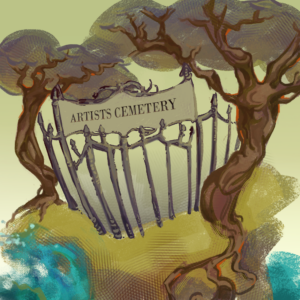
There is a place in my village, by the sea, where dreams of artistry go to die. A heavy gate and statues of crying angels hold up a sign that reads: “THE ARTISTS CEMETERY.” Inside, there’s nothing much, merely a few benches to sit on, listen to the waves, and weep. No graves as we know them. You are allowed to bury anything you want in the sand, but there are no clear guidelines on how to do it. You don’t need a gravestone or even, maybe more importantly, a body. I’ve seen people bury all kinds of things here: from small folded pieces of paper, to whole constructions too big and too complicated to describe. All with the intention for them to be carried away by the sea.
In reality, all the things they bury are sorted out by me. In a way, I’m the graveyard keeper. I take care of the dunes from time to time when nobody is around and particularly after a storm, when I get rid of all the buried stuff. Without me, there would no longer be any place left at the cemetery, and the myth of the sea taking it all helps the people part with what they bring here.
No one in town really knows when the cemetery was built. Currently it belongs to one of the wealthy people in town, but you can’t really be sure whether they even remember it, or not. The locals have always wondered about the gate that welcomes you in. Is it how it was supposed to be, or did the wind steal an apostrophe from it? And if so, was that supposed to be “The Artist’s Cemetery” as in a cemetery perhaps founded by a famous artist, or rather “The Artists’ Cemetery” as it is used till this day?
Regardless, the cemetery is open for everybody. It doesn’t discriminate between the living and the dead. People of all ages, genders, and ethnicities come to bury something whenever they feel the need to. Everybody has a little “what if” that can be too hard to carry every day, a remainder of what could’ve been, a piece of unnurtured passion, a fragment of lost and tortured wonder, a single “I’m not good enough,” a pinch of “I will not succeed,” or even a little “it is too late for me to start.” Sentimental trash. All they have to do, if they want to bury their burden, is to swear to part with it forever. There can be no resurrections. There can be no one who, after going back home, attempts to remake what they’ve left behind. It is a once and done deal. If it were any other way, the cemetery could not guarantee peace of mind the way it does.
Some, of course, are not able to comply with the rules. Digging up what you’ve buried is excommunication, and unfortunately, I’m the one who has to remind them of that. Usually, I’m kind to them. They are merely lost souls. I explain to them very gently what they’ve done, and how the sea demands the gift they’ve offered it. Most of them understand. Almost all eventually let go and forget. All, but one.
I ran into trouble with this one pretty recently. A skinny, pale guy in a long checkered trench coat, with uncut chestnut hair in disarray, absent eyes, nervous laugh. You could immediately see he was an artist. And, because he was at The Artists Cemetery, he was looking for one of two things: death or inspiration.
It was a sunny day. He approached me with a coy smile on his face.
“Do you, sir, perhaps know where I can find a decent place for a poem?”
“Any place is good for a poem. If it isn’t taken, of course. If you want, you can bury it here, right where we’re standing.”
The artist reflected for a while, looking over the dunes.
“Actually, I think I’d prefer to burn it first,” he announced.
“Well, if you must, watch out for the bushes that grow around here. It’s a dry day and we shouldn’t start a fire.”
“But of course!” he laughed briefly and left for one of the paths.
The next day, I met him again. This time, it is I who approached him.
“Are you here to bury another poem?” I asked.
He looked startled but soon broke into a short laugh.
“Oh no, no. You see, I still have the first one.”
Many people here just walk around and contemplate what they should do.
“I see. Well, I think the spot under that oak would be romantic, if you’re interested,” I remarked.
“Thank you, that’s wonderful. Although I don’t really know if ‘romantic’ is what I’m looking for.”
Now I was mildly interested.
“Is it not a romantic poem?”
“It is the greatest poem in the world.”
He didn’t elaborate and we went our separate ways.
I saw him a couple of times after that but we didn’t talk. He had a quite hard time letting go of the poem, or at least that’s what I thought all this meandering was about. One night, when I was at the cemetery in the middle of the night, about to start doing some digging, he appeared from under the woods, pale as a ghost.
“Hello. I believe we’ve met before,” he said quietly.
“It’s late. You shouldn’t be here.” I was a bit annoyed and had a terrible attitude the whole day. It’s a miracle I didn’t yell at him then and there.
“I thought moonlight would be the perfect time to bury my poem.”
“Then for fuck’s sake, just bury the poem already and stop being a pain in the ass.”
He was hurt by my sudden anger.
“I apologize, I wasn’t aware I’d done something wrong… May I just go over there and bury the poem? I will not come back and I won’t bother you anymore.”
“Go.”
And he disappeared into the darkness but instinct ordered me to follow him. I watched from a considerable distance as he crouched down, buried his hands in the sand, and recovered a small piece of paper from it.
“Hey! What do you think you’re doing?!” I yelled. “That’s somebody else’s, put it back!”
He jumped.
“No, good sir, that’s mine!”
He fled before I realized what it truly meant. All this time he was coming to the cemetery, he might’ve been doing just that. Burying and digging up a piece over and over again. It was unacceptable. This artist instantly became my worst enemy.
I tried to track him down but it was somehow impossible. He knew he was being pursued and always managed to escape my grasp. He must’ve taken this chase as a kind of challenge because it became his mission to come to the cemetery unnoticed. Those days, I stayed there longer than I usually did. He was a criminal that had to be caught.
I observed that he often wore disguises and checked everybody who visited the cemetery. I installed cameras to see the night footage. I sacrificed sleep and nutrition for my case, but it all seemed fruitless. The artist certainly wasn’t as clueless as he seemed to be. I realized that to catch him for good, I’d need a plan.
I devised a plot, simple yet quite demanding, since I was doing all that alone. I made every fence around the cemetery impenetrable, except for a small passage at the far end. From an outsider’s perspective, it was a careless omission. This entrance was located near a cliff area, where the sea waves smashed into the rocks down under. It was where I was to capture my necromancer.
It was a starry night, way too bright for what I prepared for, but I still decided to carry out my plan. I waited for him to go through the hole, come back from it, and realize he was trapped. If he had tried to escape, he’d have had nowhere to go, because while he was committing crimes against the natural law, I set up a spiked fence around us that would slow him down enough for me to capture him. His only way out was up against the cliff.
That was exactly how my plan played out. When the artist realized that he was trapped, his expression changed from playful to fearful.
“What do you want from me?” his voice was shaky.
“Calm down, little boy. Give me what you have there first.”
He was clutching a piece of paper in his fist. He backed away a few steps until he couldn’t move any further if he didn’t want to fall down from the cliff.
“I knew who you were from the start!” his tone became accusatory.
I didn’t like that. I’d never done anything wrong. I’d always been hard-working, down to earth, honest. I’d never told a lie.
“I’ve watched you here for a month!” he continued. “I’ve seen through your lies!”
Now I was furious, but I didn’t let it show.
“I said calm down! You’re going to get yourself killed!” I screamed over the wind. “Come to me. Let’s discuss… your poem.”
“Oh, please! As if I care about your opinion on it!”
“My opinion on it is perhaps the only one that matters.”
“LIAR!”
I took a deep breath.
“Be sensible. What’s the use in all this? Please, I beg you, be rational for once in your life. Look around you. Let me walk you back home. Come on, let’s go.”
I extended my hand to him, but he stayed in place, only watching it as if it were a snake.
“You’re the only thing that ever stays buried in that cemetery,” he said so quietly I wasn’t sure if I had heard that right.
“I just promise you a true view of reality. Sometimes that’s hard to accept.” I reached out my hand further.
He shook his head. I could see the tears on his cheeks shining in the starlight.
“That’s no reality. It’s… No suffering, no happiness. Just the void.” His voice was a piercing whisper. “And you won’t take me with you!”
Then he took one last step back and for a moment it was silent, before the waves and the wind howled anew, and the stars held their breaths and hid their faces behind heavy, sad clouds. A piece of paper had fallen out of his hand and landed just before me. It was completely blank.
Nothing like this has happened before and I hope it remains so. I’m not used to losing. I come out victorious from almost all cases. I’ve been here since the beginning, and I will be here after the sea washes The Artists Cemetery away, and all its dead remains break into pieces and corrode until there’s nothing left. In this one case, however, I must admit defeat.