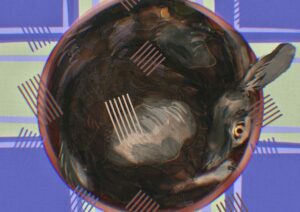
I threw away the meat. It was getting harder and harder to ignore the stench. For the first week and a half it was doable, but after Thursday it became unbearable — escaping the kitchen and crawling into the bathroom like a lumbering zombie. But can a dead rabbit actually become a zombie?
It still had its shape when I took out the trash. I watched its small body thump to the bottom of the bin, becoming the third one in a row. I’d guess the other ones were its relatives, which would make our rubbish a collective rabbit burial. The garbage service comes in a week.
I enter my mother’s bedroom, a shabby-chic amalgamation of everything she could find at the garage sales around the town during her thrifting phase five years ago. Taking into account the number of things she bought, we were lucky to find bugs in only one chest of drawers. The phase passed and the flowery curtains have been washed once ever since. She doesn’t allow me to take them off.
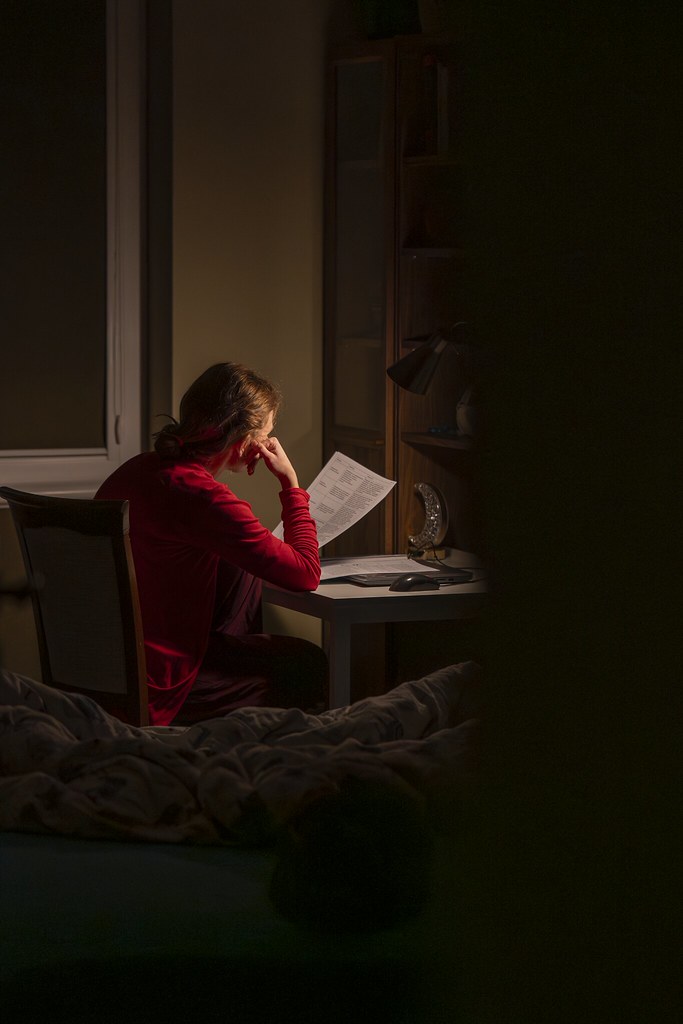
My mother rarely acknowledges my presence. As usual, she sits on her bed, in one hand her rosary and in the other a key ring. Sometimes I have an impression that instead of the beads of the rosary, she rubs the keys when praying. For now, she just stares into the wall and looks strangely collected for a person that hasn’t stepped into her own backyard for the last four years. I put on some random episode of Storage Wars. The people on the show are buying a very suspicious 1980s treadmill.
“I can make you a soup tomorrow. When they come with the meat,” I say.
“Sure,” she shrugs, eyes following an auction for a storage with one box and a chair inside.
We both know that no soup will be made. It’s been like that for a while now. They come with a fresh rabbit, fresh as a dead rabbit can be, and it lies lays in our fridge for a week until I throw it away. And she eats Pop-Tarts and washes them down with milk. But the soup hangs there, like a promise, and I always tell the rabbit guy to bring another one next week.
My mother has been tied to this house since the death of my father. Twenty years older than her, he married her when he was already a well-established lawyer with a swimming pool and the work habits of a workaholic: out in the morning, back in the evening. Except when he didn’t come back. They found him dead in his car in front of his young intern’s house—thirty‑five years younger. A cerebrovascular accident. A stroke.
Did my mother love him? She was faithful, and to her that was worth more than any love or any air‑touched ex‑cheerleader with a Christmas wreath still hanging on her door in June. She always waited for him in the same spot on the couch, and eventually it wore through and we had to hide the damage with cushions when guests came.
Neither of us knew about the intern. His office was always locked, and we weren’t allowed inside. When I asked my mother why we still couldn’t enter it now, she said he swallowed the key the moment he knew he would die.
I would believe her if half the rooms in this house weren’t shut and she didn’t have a bunch of keys she never uses. Maybe you swallowed it, I want to say.
After Barry Weiss buys another shitty storage unit and loses five hundred dollars, I make her go with me to the bathroom.
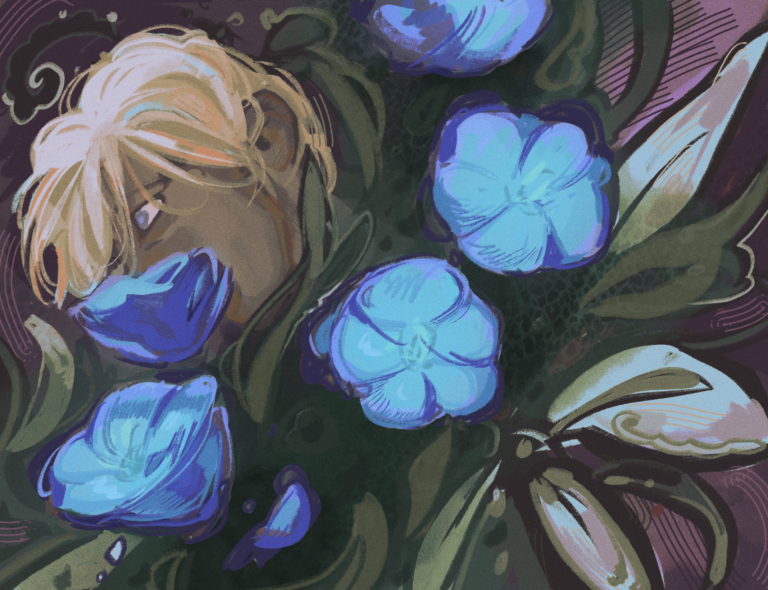
I help her undress and sit in the bathtub. Hot water makes her skin look like a rabbit’s; even the pattern of tendons is similar. I lather her in soap and balm, sweep the curtain dust from her shoulders. I don’t like doing it. What’s human stops being human. A piece of flesh. A block of meat. I marinate her in chamomile and lavender, and she starts to smell like my mother again.
Wrapped in a towel, she sits on the rim and I brush her hair.
“I had a semi‑wild rabbit when I was a child, you know,” she says. Every evening the same scenario. “It had a name. Dylan. It was called Dylan, you know.”
I know. I listen to it every day.
“And then I got very sick. And my father said we had to make a soup to make me feel good again. But it was very expensive. The meat. Do you think it was my fault?”
“No, mother. Of course not.”
“But I got better after it. They let me keep his paw. His little paw. We have to try it again. It will help me again. And I will get better. I know I will. Please call the butcher. Could you call him, please? And make me a soup?”
The hairs I pull from the brush are barely auburn now. I wonder if she even realizes it.
“Do you want me to do it now, mother?”
“Maybe tomorrow. Or the day after tomorrow. I will tell you.”
She never tells me. The only time she speaks to me is in the bathroom.
And then I flush the water down the drain.
The living room is where I sleep, solve crosswords, and eat ready‑made pasta sets from the supermarket. My old room now serves as a closet and a mausoleum of prom dresses that have never been sent to the cleaner’s. Since I moved some of the clothes downstairs, I rarely go up there; it’s too stuffy anyway. After a whole day of sun bombarding the windows, my old teddy bears have their own circle of hell.
The couch stands in front of the door, and every night I imagine someone entering in the dark. And I lie there, doing nothing, letting them take anything that could be sold later. I could warm a Pop‑Tart in the microwave before they take it. Maybe I’d cling to it and get taken away, too.
If I didn’t worry about my mother, I’d open the door at night and let the air winnow through the house until I felt it at the back of my throat. Air out the carpets, breeze off the heat lingering at the nape of my neck. Hang me out with the wash. I wouldn’t mind.
Humming, I curl up under a blanket and dream of cold Californian nights.
The next day I wake up and eat a toast. Take a rabbit from the rabbit guy. Ignore mail.
We watch The Real Housewives. My mother does not want to be washed. My mother does not want to go to sleep.
I give her a sleeping pill.
And I take one, too.
We sleep until noon. My armpits are sweaty, so I go into a bathtub, and scrub it away.
“Do you miss my father?” I ask her.
“Does he miss me?” she says.
I clench my jaw. A bead follows a bead.
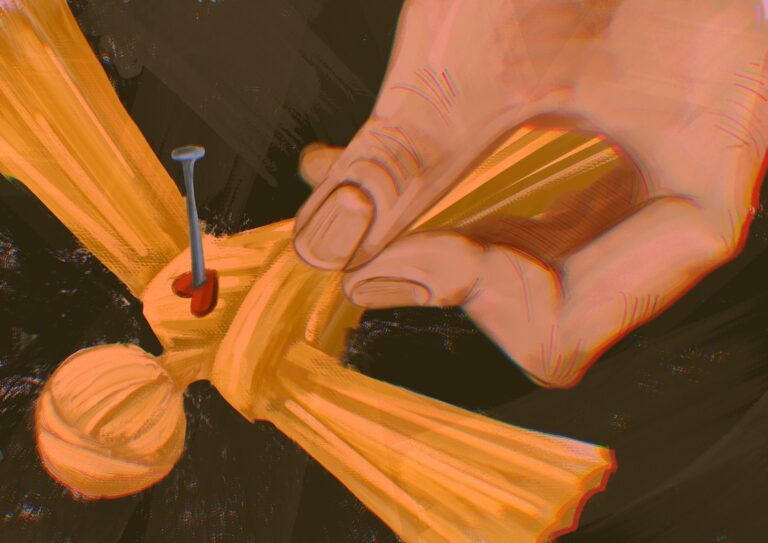
“Did you know the pink bunny in dungarees belonged to his second wife, and she bought it for a child they were supposed to have?” she says. “And the swing you loved so much — his first wife made it. She hammered a nail into the tree and laughed, and he said, I love you so much. And she was just laughing and laughing, until he couldn’t take it any longer. And the second wife asked, Were you ever married? No, I wasn’t, he said, and I love you. But she spent so much time in the bathroom that once she just didn’t leave it. He took me to see their graves. I get unlucky with my wives, he said. You will be my lucky one. He gave me the keys and said he would check every day if I ever used them.”
I let the water run until it’s as high as the rim.
“I was the perfect wife. I let him have secrets. And all I get is him dying. I still don’t know what his office looks like. I don’t need to know. He can come anytime and check the keys. Check that I didn’t use them.”
I immerse my whole face in the suds. My eyeballs begin to prickle.
“I won’t be like the others, I told him. You will have your life, and I will be a part of it. Love me, I told him. Love me. Did he? Did he ever?”
“Mother.”
“I could bury somebody dead or alive if he asked. I could have another Dylan and kill him. Just love me.”
“Mother.”
“Don’t call me that. I am a wife.”
Her birthday comes when I’ve already forgotten it. The only birthday card we get is from a bank anyway: a stock photo of a smiling lady and a flashy caption. Don’t wait — book an appointment to prepare a personalized plan for managing your account, even twenty years into the future.
I take it to the kitchen and leave it on the counter, next to the rabbit delivered a day ago. I put on a Dolly Parton album — the one that always woke me up after my father got home at two in the morning, a push‑up bra from Frederick’s and five‑inch heels pulsing against the terracotta tiles.
The meat spills out of my hands. I hold it still and slice it into smaller parts to get rid of anything unnecessary. It sticks to the cutting board with the sound of sweaty thighs pressing into a leather armchair. I squeeze it and feel my guts wrench into a knot.
I didn’t think of buying any fresh vegetables. I drop in a frozen carrot and a celery stick and stare into the water, willing it to boil faster. The rabbit doesn’t look like a rabbit anymore.
For an hour, I sit at the counter and swing my legs.
For an hour, I dream of a human‑sized pot into which I could jump like into a bathtub. My skin sizzles. My hair unbraids, and I swallow all the water until it’s empty.
I wish I were a rabbit.
When it’s done, I call my mother from downstairs, but she doesn’t respond. At the back of the cabinet, I find a bowl last used two years ago, when I still had the energy to clean it after eating.
I climb the stairs. The door to my mother’s bedroom is open; I can smell the chamomile and lavender. The pale cut‑out of the window crawls across the flowery carpet.
She’s not there, and it’s like I almost expected it. The sleeping gown left on the puffy satin hanger, the duvet in stagnant coils. No one is buying anything on the screen. No rosary, no key ring. A dead rabbit on the pillow.
I dig a hole in the backyard and bury it. Then I walk into the street and sit on the curb. I smell the hot asphalt. Press my palm into the concrete. Squint at the white sun.
I haven’t eaten an ice cream in four years.